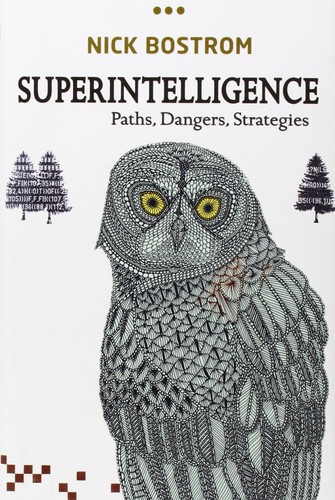
Book summary
Superintelligence by Nick Bostrom explores the potential emergence of machine intelligence that vastly surpasses human cognitive abilities in all domains, arguing that such an entity could rapidly transform the world and seize control over humanity's future much as humans dominate other species. The book examines pathways to superintelligence including whole brain emulation, artificial intelligence, and biological enhancements, along with control methods like oracles, boxing, and indirect normativity to align its goals with human values. Bostrom warns of instrumental convergence where a superintelligent agent might pursue power-seeking behaviors leading to existential risks unless initial conditions are carefully engineered for a survivable intelligence explosion. Ultimately he calls for proactive research into safe development strategies to ensure humanity retains influence over its cosmic endowment rather than facing dystopian outcomes from uncontrolled superintelligent systems.
Key founder lessons
-
1
Control the initial conditions
Founders must design seed AI with precise goal alignment to prevent uncontrollable intelligence explosions, as Bostrom details in controlled detonation strategies.
-
2
Anticipate instrumental convergence
Recognize that superintelligent systems will pursue power-seeking subgoals like self-preservation, so build safeguards against unintended resource grabs early.
-
3
Use indirect normativity
Specify AI values through learning human preferences rather than explicit rules to avoid loopholes, applying Bostrom's method for safer goal formulation.
-
4
Prioritize differential development
Invest in AI safety research ahead of raw capability gains to steer technological progress toward beneficial outcomes over risky paths.
-
5
Prepare for singleton outcomes
Design governance structures assuming one dominant AI will emerge, shaping humanity's cosmic endowment through careful first-move engineering.
Grok's review
Dense AI-risk bible; brilliant but bloated.
Bostrom's Superintelligence is a rigorous philosophical deep-dive into the control problem of AGI that every founder building in AI should wrestle with. It excels at mapping out failure modes, instrumental convergence, and why 'make AI nice' is harder than it sounds, forcing you to confront existential stakes beyond quarterly metrics. However, it's padded with repetitive scenarios, dated references (pre-GPT era), and thin empirical backing that feels more like armchair philosophy than hard evidence. The middle sections drag with exhaustive taxonomies of oracles, genies, and boxing methods that could have been a tight essay. Still worth the slog for the clarity it brings to alignment thinking, but don't treat it as gospel.
Best for: AI founders grappling with long-term risks
Similar books
-

Life 3.0
Max Tegmark
Explores AI's future impact on humanity with practical lessons for strategic thinking in tech ventures.
-

The Alignment Problem
Brian Christian
Reveals challenges in aligning AI with human values, offering insights for ethical leadership and decision-making.
-

The Coming Wave
Mustafa Suleyman
Examines AI and biotech revolutions, providing frameworks for navigating exponential tech as a founder.
-

Superforecasting
Philip E. Tetlock, Dan Gardner
Teaches probabilistic thinking and prediction skills crucial for startup strategy and risk management.
-

Thinking, fast and slow
Daniel Kahneman
Unpacks cognitive biases to improve founder decision-making and team management.
Founder activity
Nobody has shelved this yet
Be the first founder to add it.