
Book summary
The Climb by Anatoli Boukreev and G. Weston Dewalt is a firsthand account of the deadly 1996 Mount Everest disaster in which eight climbers died during a sudden blizzard. Boukreev, a highly experienced Kazakhstani guide, recounts the events from his perspective as part of the Adventure Consultants expedition led by Scott Fischer, defending his controversial decision to descend ahead of clients without supplemental oxygen while emphasizing the role of poor planning, over-reliance on inexperienced clients, and inadequate leadership. The core argument is that media portrayals unfairly blamed guides like Boukreev while ignoring systemic failures in commercial high-altitude mountaineering, asserting that individual skill, rapid action, and self-reliance ultimately saved lives amid the chaos.
Key founder lessons
-
1
Adapt plans to real-time conditions
Boukreev's decision to summit without oxygen and descend quickly allowed him to rescue others when storm hit, teaching founders to stay flexible and act decisively amid uncertainty.
-
2
Prioritize self-reliance over groupthink
Boukreev climbed light and fast independently rather than following commercial expedition norms, showing founders the value of trusting personal judgment over consensus.
-
3
Master your craft through relentless preparation
His years of high-altitude experience enabled critical rescues in the disaster, reminding founders that deep expertise is the foundation for performing under extreme pressure.
-
4
Take calculated risks with clear trade-offs
Forgoing supplemental oxygen traded personal comfort for speed and strength later, illustrating how founders must weigh specific risks against strategic advantages.
-
5
Focus on core mission amid chaos
Boukreev repeatedly returned to save lives while others panicked, teaching founders to maintain clarity on what truly matters when everything is falling apart.
Grok's review
Gripping survival tale, weak leadership lessons.
The Climb delivers a raw, first-person counter-narrative to Krakauer's Into Thin Air, with Boukreev's stoic competence shining through the chaos of the 1996 Everest disaster. What works is the unfiltered intensity and his emphasis on personal responsibility over groupthink, which can resonate with founders who value decisive action in crises. However, it suffers from padding in the form of repetitive justifications and defensive rebuttals, dated expedition-management ideas that feel more like macho mountaineering lore than scalable strategy, and thin evidence when Boukreev leans on 'I just knew' intuition without deeper analysis. For startup founders, it's an entertaining read on high-stakes decision-making under extreme pressure but ultimately not essential; the leadership takeaways are anecdotal at best and don't translate cleanly to building teams or products.
Best for: Founders who love adventure metaphors and crisis autopsies.
Similar books
-

Endurance
Alfred Lansing, Elena Grau
Gripping tale of leadership and resilience under extreme adversity, with direct lessons for building and sustaining teams.
-
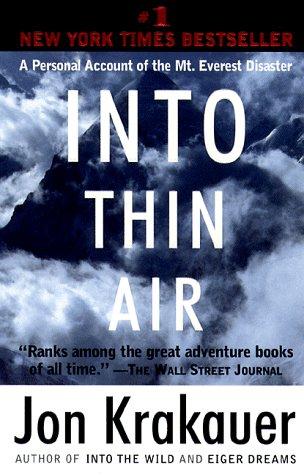
Into Thin Air
Jon Krakauer
Raw account of high-stakes decision-making and crisis management that mirrors startup pressure and risk.
-

The Right Stuff
Tom Wolfe
Explores courage, excellence, and the psychology of elite performers, offering insights for high-performance company culture.
-

Touching the void
Joe Simpson, Joe Simpson
Story of survival, trust, and tough choices that parallels the grit needed to navigate startup failures.
-

Shoe Dog
Phil Knight
Founder's memoir of relentless perseverance and building Nike from scratch, full of practical startup wisdom.
-
The Hard Thing About Hard Things
Ben Horowitz
Unflinching guide to the brutal realities of scaling a company, emphasizing resilience and decisive leadership.
Founder activity
Nobody has shelved this yet
Be the first founder to add it.