
Book summary
Where Good Ideas Come From by Steven Johnson explores the origins of innovation through the concept of the "slow hunch," showing how groundbreaking ideas rarely emerge as sudden flashes of insight but instead develop gradually over time as connections form between existing concepts. Central to his argument is the "adjacent possible," the idea that every new innovation expands the realm of what is possible next by building directly on the scaffolding of prior discoveries. Johnson traces this pattern across history and disciplines, using examples from science, technology, and culture to illustrate how environments that foster collaboration, open networks, and the free exchange of ideas—like cities, coral reefs, and the internet—generate more innovation than isolated genius. Ultimately he argues that modern innovation is shifting from the lone inventor pursuing private profit to collective, public-spirited endeavors where many minds build cumulatively on one another's work.
Key founder lessons
-
1
Embrace the slow hunch
Founders should nurture half-formed ideas over years, as Johnson shows innovations like Darwin's evolution theory emerge gradually from persistent reflection.
-
2
Expand the adjacent possible
Build on existing ideas to unlock new possibilities, since Johnson illustrates how the adjacent possible grows only through prior innovations and connections.
-
3
Foster liquid networks
Create environments for ideas to collide, like coffeehouses or modern online platforms, as Johnson credits dense, fluid networks for sparking breakthroughs.
-
4
Prioritize open platforms
Shift from lone inventor profit models to collaborative public good, mirroring Johnson's history of ideas thriving in open, shared intellectual ecosystems.
-
5
Value serendipitous connections
Design for unplanned encounters and cross-pollination, because Johnson demonstrates how hunches combine accidentally in diverse, error-friendly settings to yield innovation.
Grok's review
Charming but padded history lesson for idea junkies.
Johnson's core ideas—slow hunches, the adjacent possible, and the power of networked collaboration—are genuinely useful for founders navigating uncertainty and innovation. The historical anecdotes are engaging and the shift from lone inventor to open ecosystems feels prescient for modern startups. That said, the book is padded with repetitive storytelling, the evidence is more illustrative than rigorous, and some examples already feel dated in our AI-augmented world. It's worth a read if you enjoy popular science on creativity, but don't expect a tactical playbook; it's more inspirational than operational.
Best for: Founders obsessed with creativity and innovation history.
Similar books
-
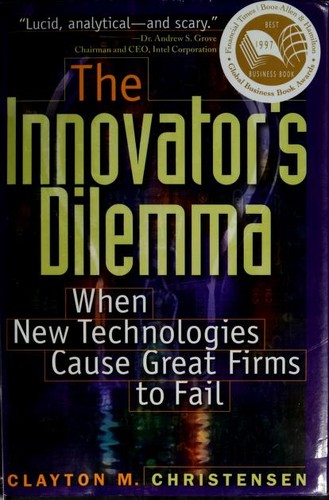
The Innovator's Dilemma
Clayton M. Christensen, L J Ganser
Reveals why successful companies fail at disruptive innovation, with timeless lessons on adaptation.
-

How Innovation Works
Matt Ridley
Explores the messy, networked reality of innovation, offering practical insights for building creative organizations.
-

Range
David J. Epstein
Shows why generalists outperform specialists, with lessons on fostering versatile thinking in teams.
-

The Medici Effect
Frans Johansson
Demonstrates how intersections of fields spark breakthrough ideas, guiding diverse team strategies.
-

Antifragile
Nassim Nicholas Taleb, Genís Sánchez Barberán
Teaches building systems that thrive on disorder, essential for resilient startup strategies.
-

The Black Swan
Nassim Nicholas Taleb, David Chandler
Explains unpredictable events and how to prepare, sharpening decision-making under uncertainty.
Founder activity
Nobody has shelved this yet
Be the first founder to add it.