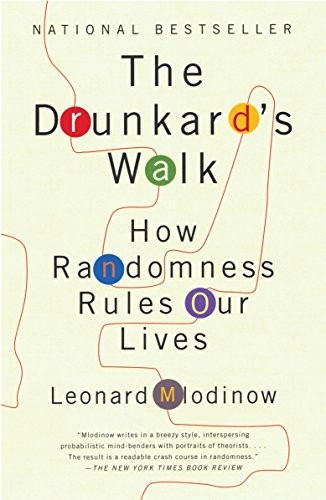
Book summary
The Drunkard's Walk by Leonard Mlodinow explores how randomness chance and probability shape our lives far more than we realize often leading us to mistakenly credit success or failure to skill innate talent or clear causes. Through engaging examples from sports business wine tasting education and everyday decisions the book reveals the psychological illusions and cognitive biases that make us overlook the role of luck while overestimating predictability and control. Mlodinow argues that by understanding the true nature of random events and statistical thinking we can make wiser judgments avoid misinterpreting data and better appreciate what is genuinely meaningful in an uncertain world. The core message is that much of what we attribute to deliberate planning or exceptional ability is profoundly influenced by the unpredictable steps of a metaphorical drunkard's walk.
Key founder lessons
-
1
Luck masquerades as skill
Founders often credit talent for successes that randomness heavily influenced, like a viral launch, leading to overconfidence in future predictions.
-
2
Regression to the mean rules
Exceptional early results in metrics or funding will likely normalize; avoid overreacting to streaks by focusing on process over outcomes.
-
3
Randomness inflates judgments
Investor feedback, press coverage, or market reactions contain large chance elements; evaluate decisions with probabilistic thinking rather than binary success/failure.
-
4
Illusion of control deceives
CEOs and founders attribute company trajectories to strategy when luck plays a bigger role; build antifragile plans that account for unpredictability.
-
5
Probability trumps certainty
Use Bayesian updating on data like customer behavior instead of seeking illusory patterns, improving pivots and resource allocation under uncertainty.
Grok's review
Entertaining probability primer, but padded and light on startup utility.
Mlodinow writes with a breezy, irreverent style that makes concepts like regression to the mean, Bayes' theorem, and the illusion of control go down easy—perfect for founders who glaze over at math. The wine-tasting and sports anecdotes are memorable and hammer home how much randomness masquerades as skill, which is a useful gut check when you're reading your own press clippings or Series A term sheet. That said, the book feels padded with historical digressions and celebrity stories that could have been cut by a third, the evidence is mostly illustrative rather than rigorous, and some of the examples already felt dated when it came out in 2008. It's not a decision-making manual like Thinking, Fast and Slow; it's more of a consciousness-raiser that leaves you nodding but without a clear toolkit to apply on Monday morning.
Best for: Founders prone to over-attributing success to genius
Similar books
-

Thinking, fast and slow
Daniel Kahneman
Reveals cognitive biases that shape decisions, helping founders avoid judgment errors in business and strategy.
-
Fooled by randomness
Nassim Nicholas Taleb
Exposes how luck and randomness mislead us, teaching founders to build resilient companies amid uncertainty.
-
The Signal and the Noise
Nate Silver
Teaches probabilistic thinking and separating signal from noise, vital for data-driven startup decisions.
-

Superforecasting
Philip E. Tetlock, Dan Gardner
Shows how to improve predictive accuracy, equipping founders with better forecasting skills for markets and strategy.
-
Algorithms to Live By
Brian Christian, Tom Griffiths
Applies computer science concepts to everyday decisions, offering productivity and optimization lessons for leaders.
-

The psychology of judgment and decision making
Scott Plous
Explores biases in human judgment, providing practical insights to improve founder decision-making and team management.
Founder activity
Nobody has shelved this yet
Be the first founder to add it.