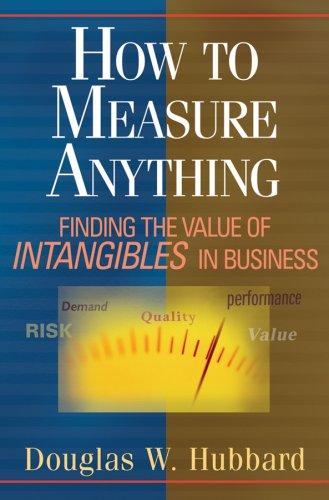
Book summary
How to Measure Anything by Douglas W. Hubbard is a practical guide that debunks the myth that certain things like intangibles, risks, and uncertainties cannot be measured. The core argument is that anything can be measured if "measurement" is redefined as reducing uncertainty through observation, using techniques from statistics, decision theory, and simple probabilistic models rather than requiring perfect precision. Hubbard introduces methods like calibrated probability estimates, Monte Carlo simulations, and value-of-information analysis to quantify even the most elusive variables in business, science, and everyday decision-making. The book ultimately shows that better measurements lead to better decisions by focusing effort where uncertainty reduction has the highest payoff.
Key founder lessons
-
1
Quantify the Unmeasurable
Use probabilistic models and Monte Carlo simulations to measure uncertain variables like market demand or product value that seem impossible to quantify.
-
2
Apply the Value of Information
Prioritize measurements by calculating expected value of information to focus only on what reduces uncertainty enough to change decisions.
-
3
Use Bayesian Updating
Start with calibrated estimates as priors and iteratively update beliefs with new evidence to improve decision accuracy under uncertainty.
-
4
Calibrate Your Estimates
Train yourself to give 90% confidence intervals that are accurate by recognizing and reducing overconfidence bias in forecasts.
-
5
Measure with Imperfect Data
Employ small sample sizes, proxies, and controlled experiments to derive actionable insights without needing perfect or large datasets.
Grok's review
Useful toolkit, bloated with repetition.
Hubbard's core thesis—that anything can be measured with the right probabilistic approach and simple math—is genuinely empowering for founders drowning in uncertainty around product-market fit, customer value, or growth metrics. The book shines when it demystifies measurement as calibrated estimates, Monte Carlo simulations, and Bayesian updates rather than requiring perfect data; many startup operators have used it to start quantifying the supposedly unquantifiable. However, it's padded with repetitive case studies, overly broad claims, and some dated references (pre-big-data era), plus the evidence often feels like selected success stories without rigorous counterexamples. It's worth a founder's time if you skim aggressively past the filler, but don't treat it as gospel.
Best for: Founders uncomfortable with ambiguity in decision-making
Similar books
-

Thinking, fast and slow
Daniel Kahneman
Reveals cognitive biases and decision-making flaws critical for better business judgments.
-
The Signal and the Noise
Nate Silver
Teaches probabilistic thinking and separating meaningful data from noise in uncertain environments.
-

Superforecasting
Philip E. Tetlock, Dan Gardner
Shows how to improve predictive accuracy through practical techniques applicable to startup strategy.
-
Algorithms to Live By
Brian Christian, Tom Griffiths
Applies computer science algorithms to everyday decisions, boosting productivity and efficiency.
-
Fooled by randomness
Nassim Nicholas Taleb
Explores luck versus skill in outcomes, helping founders navigate uncertainty and risk.
Founder activity
Nobody has shelved this yet
Be the first founder to add it.