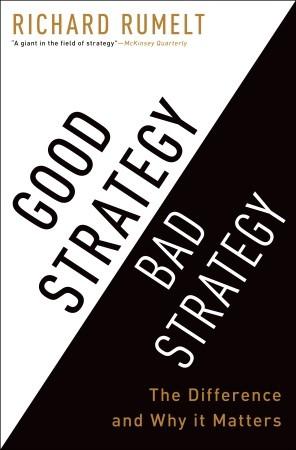
Book summary
Good Strategy Bad Strategy by Richard Rumelt explains that a good strategy is a coherent set of actions rooted in a clear diagnosis of the most important challenges in a situation, followed by a guiding policy and focused resource deployment to leverage strengths and overcome obstacles. In contrast, bad strategy is a collection of vague aspirations, wishful thinking, and buzzwords that fail to confront real problems or concentrate effort. Through numerous case studies from business, military, and government, Rumelt demonstrates how kernel-based good strategy delivers real progress while bad strategy creates the illusion of progress without substance. The core argument is that true strategy is about making hard choices and focusing resources on what matters most rather than pretending everything can be achieved at once.
Key founder lessons
-
1
Diagnose the critical challenge
Founders must deeply analyze the specific situation to identify the pivotal obstacle before crafting any plan.
-
2
Create a guiding policy
Define a clear approach that leverages strengths to overcome the diagnosed challenge without exposing weaknesses.
-
3
Design coherent actions
Concentrate resources on a set of coordinated steps that directly support the guiding policy and diagnosis.
-
4
Avoid bad strategy fluff
Reject lists of vague goals, wishful thinking, and buzzwords that lack diagnosis, policy, or focused actions.
-
5
Use kernel for strategy
Build every startup plan around the three-part kernel of diagnosis, guiding policy, and coherent actions.
Grok's review
Essential kernel, bloated execution.
Rumelt nails the core insight that good strategy is a coherent response to a diagnosed challenge with a guiding policy and coherent action—something most startup founders desperately need but rarely practice. The book is opinionated and clear-eyed about how bad strategy masquerades as vision, ambition, or fluffy lists of goals, which is a brutal mirror for any team chasing hockey-stick growth without focus. That said, it's padded with repetitive case studies that could have been halved, some examples feel dated (pre-2010 business landscape), and the evidence is more anecdotal than rigorous. Still, the central framework is gold for founders; it's one of the few strategy books that actually changes how you think about resource allocation and competitive advantage.
Best for: Founders struggling with focus and prioritization.
Similar books
-
The Lean Startup
Eric Ries
Teaches rigorous experimentation and adaptive strategy to turn vision into validated business success.
-

Playing to win
A. G. Lafley
Delivers a practical framework for making clear strategic choices that drive competitive advantage.
-

High Output Management
Andrew S. Grove
Offers timeless principles on operational excellence and people management for scaling companies.
-
The Hard Thing About Hard Things
Ben Horowitz
Shares raw lessons on navigating crises and leading through the unpredictable realities of startups.
-

Good to Great
Collins, James C., Jim Collins
Reveals data-driven insights on what distinguishes enduring companies from merely good ones.
-

Thinking, fast and slow
Daniel Kahneman
Illuminates cognitive biases to improve strategic decision-making and avoid common leadership pitfalls.
Founder activity
Nobody has shelved this yet
Be the first founder to add it.