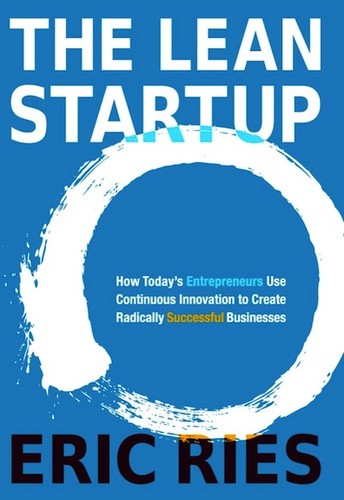
Book summary
The Lean Startup by Eric Ries presents a systematic methodology for building successful businesses under conditions of extreme uncertainty by emphasizing validated learning over intuition or elaborate planning. Ries argues that most startups fail not from poor execution but from creating products nobody wants, so entrepreneurs should treat their venture as a grand experiment focused on rapidly testing core assumptions through minimum viable products, customer feedback loops, and iterative pivots. The core argument is that continuous scientific experimentation—measuring real customer behavior, learning what works, and either persevering or changing direction—dramatically reduces waste and increases the odds of creating a sustainable company, whether in a garage startup or inside a large corporation. This approach shifts the emphasis from product-centric development to customer-centric adaptation in tiny increments.
Key founder lessons
-
1
Build-Measure-Learn Loop
Founders iterate rapidly by building MVPs, measuring customer data, and learning to pivot or persevere, minimizing waste.
-
2
Validated Learning
Test assumptions through experiments with real customers to confirm what they actually want before scaling.
-
3
Minimum Viable Product
Launch the simplest version that tests key hypotheses, gathering feedback to guide product decisions efficiently.
-
4
Innovation Accounting
Track progress with actionable metrics focused on learning and growth, not vanity numbers like total users.
-
5
Pivot or Persevere
Use insights from customer feedback to change strategy direction when data shows the current path isn't working.
Grok's review
Still influential but padded and dated.
The Lean Startup crystallized a generation of startup thinking around MVPs, pivots, and validated learning, turning customer development into something operational and repeatable. Its core insight—that most startups die from building the wrong thing under uncertainty—remains brutally relevant. However, the book is bloated with repetition, feels like a long blog series stretched into 300+ pages, and leans heavily on thin, cherry-picked anecdotes rather than rigorous evidence. Some mechanics (especially the emphasis on continuous deployment and split testing) have aged poorly in an era of AI, no-code tools, and attention-saturated markets where 'build-measure-learn' can become a recipe for shallow iteration instead of deep insight. Worth reading once, but don't treat it as gospel.
Best for: First-time founders needing process discipline.
Similar books
-
The Hard Thing About Hard Things
Ben Horowitz
Raw lessons on leadership and tough decisions every founder faces when scaling.
-
Zero to One
Peter A. Thiel, Blake Masters
Teaches building monopolies through innovation and avoiding competition.
-

High Output Management
Andrew S. Grove
Timeless principles for managing teams and driving operational excellence.
-

The mom test
Rob Fitzpatrick
Master customer conversations to validate ideas without bias.
-

Blitzscaling
Reid Hoffman
Strategies for rapid growth in uncertain environments like startups.
-

Thinking, fast and slow
Daniel Kahneman
Insights on decision-making biases to improve founder judgment.
Founder activity
Nobody has shelved this yet
Be the first founder to add it.