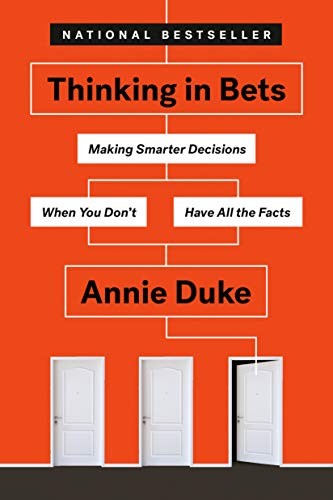
Book summary
Thinking in Bets by Annie Duke argues that effective decision-making requires embracing uncertainty and separating the quality of decisions from their outcomes since luck always plays a role. Drawing on her experience as a professional poker player the book teaches readers to view choices as bets with probabilities rather than quests for certainty allowing better calibration of confidence levels and more rational evaluation of hidden information and future possibilities. Duke emphasizes shifting from outcome-based judgment to process-oriented thinking which reduces emotional reactivity cognitive biases and hindsight bias while improving long-term results in business sports politics and everyday life. The core message is that getting comfortable with "I'm not sure" and focusing on decision quality over immediate results leads to greater success and peace of mind.
Key founder lessons
-
1
Resulting: separate process from outcome
Founders must evaluate decisions based on quality at the time, not luck-influenced results, to avoid punishing good risks that fail.
-
2
Embrace uncertainty with probabilistic thinking
Assess every startup bet by assigning probabilities to outcomes instead of seeking false certainty, improving long-term decision accuracy.
-
3
Seek out-of-group views to reduce bias
Actively consult dissenting opinions before committing resources, countering echo chambers that distort founder judgment.
-
4
Use a decision journal for accountability
Record predictions, confidence levels, and reasoning upfront so you can learn from actual versus expected results without hindsight bias.
-
5
Focus on future expected value, not past sunk costs
Continually reassess startup initiatives by their forward odds of success, abandoning paths even after heavy investment if new information lowers EV.
Grok's review
Solid decision framework, padded with poker war stories.
Thinking in Bets does a good job reframing outcomes as a mix of skill and luck, which is genuinely useful for founders who tend to over-attribute wins to genius and losses to bad luck. Duke's core idea—treat decisions like bets by focusing on probabilities rather than binary right/wrong—helps build better mental models for hiring, product bets, and fundraising. The poker anecdotes are engaging at first but quickly feel repetitive and padded, stretching what could be a crisp 100-page book into 250 pages of familiar behavioral econ lite (Kahneman, Tetlock, etc.). Evidence is mostly illustrative rather than rigorous, and some of the corporate examples already feel a bit dated. Still, the mental shift it encourages is valuable enough that many startup operators will benefit, especially those prone to outcome bias or founder overconfidence.
Best for: Founders wrestling with uncertainty and outcome bias.
Similar books
-

Thinking, fast and slow
Daniel Kahneman
Reveals cognitive biases affecting decisions, sharpening judgment crucial for founders.
-
Fooled by randomness
Nassim Nicholas Taleb
Explores luck versus skill in outcomes, helping separate signal from noise in business.
-

The Psychology of Money
Morgan Housel
Uncovers timeless behaviors around risk and luck that drive better financial decisions.
-

Superforecasting
Philip E. Tetlock, Dan Gardner
Shows how to improve predictive accuracy, vital for strategic startup choices.
-

Range
David J. Epstein
Champions broad experience over specialization, boosting adaptability in uncertain ventures.
Founder activity
Nobody has shelved this yet
Be the first founder to add it.