Book summary
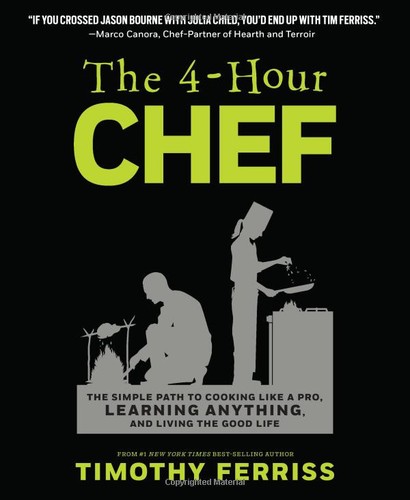
The 4-Hour Chef by Timothy Ferriss is a meta-learning guide disguised as a cookbook that teaches readers how to rapidly acquire any skill by applying the principles of accelerated learning to cooking. Ferriss breaks down complex culinary techniques into simple deconstructed methods drawing from top chefs while using cooking as a vehicle to explore meta-skills like deconstruction, selection, sequencing, and experimentation that can be transferred to any domain. The book argues that with the right shortcuts and focus on the 20 percent of information that yields 80 percent of results anyone can become competent quickly and that true mastery comes from embracing failure and constant iteration. Ultimately it positions cooking not as an end but as a practical laboratory for improving learning efficiency productivity and life itself.
Key founder lessons
-
1
Deconstruct to learn rapidly
Break any skill into its minimal viable components first, then practice only those to accelerate mastery as Ferriss does with cooking techniques.
-
2
Use the 80/20 rule for skills
Focus on the 20% of techniques or ingredients that deliver 80% of results, allowing founders to prioritize high-impact actions over exhaustive learning.
-
3
Employ DiSSS for skill acquisition
Apply Deconstruction, Selection, Sequencing, and Stakes to systematically learn any new domain, turning cooking experiments into repeatable startup experimentation frameworks.
-
4
Test failure points early
Intentionally provoke and study mistakes in controlled ways, as Ferriss does with recipes, to identify and fix critical startup risks before scaling.
-
5
Meta-learn by teaching others
Document and share your process publicly to reinforce knowledge and build community, mirroring how Ferriss turns personal experiments into influential books and brands.
Grok's review
Brilliant meta-learning gimmick, bloated execution.
Ferriss turns cooking into a Trojan horse for rapid skill acquisition, meta-learning principles, and his signature deconstruction approach, which is genuinely useful for founders who want to systematize learning anything. The early sections on how to learn efficiently (DiSSS and CaFE frameworks) are sharp and worth the price of admission alone. But the book is massively padded with hundreds of pages of recipes, food porn, and tangential stories that feel like filler to hit a page count. Many of the 'hacks' and scientific claims are thin on rigorous evidence, some ideas already felt dated by 2012, and the relentless self-promotion grates. It's not really a cookbook, nor is it a pure learning manual; it sits awkwardly between both and does neither perfectly.
Best for: Founders obsessed with rapid skill acquisition and meta-learning.
Similar books
-

The 4-Hour Workweek
Timothy Ferriss
Master lifestyle design, automation, and selective ignorance to reclaim time while scaling a business.
-

Tools of Titans
Timothy Ferriss
Condensed wisdom from world-class performers on habits, decision-making, and high-performance routines.
-

Atomic Habits
James Clear
Build systems for tiny daily improvements that compound into massive career and company growth.
-
Deep Work
Cal Newport
Cultivate focused intensity to produce elite output and stand out in a distracted startup world.
-
The Lean Startup
Eric Ries
Learn scientific experimentation and validated learning to efficiently build and pivot products.
-

Mindset
Carol S. Dweck
Adopt a growth mindset to embrace challenges and accelerate personal and team development.
Founder activity
Nobody has shelved this yet
Be the first founder to add it.