Book summary
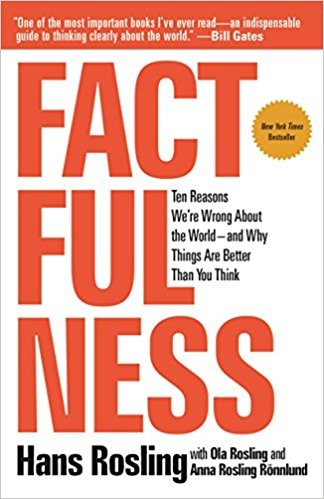
Factfulness by Hans Rosling, Ola Rosling, and Anna Rosling Rönnlund argues that humans systematically misunderstand global trends due to ten instinctive cognitive biases that distort our worldview, such as dividing the world into simplistic categories like developed versus developing, assuming things are getting worse, and overreacting to fear-driven media. The authors demonstrate through data and quizzes that the world is far better than most people believe—with dramatic declines in poverty, child mortality, and illiteracy, plus improvements in health, education, and equality—yet our ignorance prevents accurate assessment and effective action. By cultivating "factfulness," a habit of relying only on verified data and updating beliefs accordingly, we can reduce stress, focus on genuine problems, and make better decisions about the future. The book combines statistics, personal anecdotes from Rosling's global health work, and practical tools to override biases and embrace an evidence-based optimism grounded in reality.
Key founder lessons
-
1
Instinct of the Gap: Avoid binary divides.
Founders should track nuanced metrics like income levels 1-4 instead of rich/poor to accurately assess market opportunities and global trends.
-
2
Negativity Instinct: Question bad news bias.
Founders must seek data on improving trends in health, education, and tech adoption to maintain optimism and spot emerging markets.
-
3
Straight Line Instinct: Expect S-curves.
Founders should anticipate gradual then explosive growth in metrics like user adoption or GDP, avoiding premature scaling decisions.
-
4
Fear Instinct: Prioritize real risks.
Founders can focus resources on high-impact threats like pandemics or climate data rather than media-hyped fears, improving strategic allocation.
-
5
Size Instinct: Use rates, not absolutes.
Founders should compare per-person or percentage figures when evaluating markets or problems to avoid overreacting to large raw numbers.
Grok's review
Optimistic data gospel with TED-talk padding.
Factfulness is a breezy, optimistic corrective to the doom bias most of us carry, hammering home that global trends in poverty, health, and education are far better than our instincts suggest. Rosling's ten instincts framework is genuinely useful for any founder who wants to cut through hype and media panic when evaluating markets or impact theses. That said, the book is heavily padded with repetitive anecdotes, overly theatrical examples from his TED fame, and some sections that already feel dated given post-2018 shifts in global fertility, geopolitics, and inequality. The evidence, while directionally right, is sometimes thin or overly aggregated, glossing over important variance that matters for startup strategy.
Best for: Founders fighting pessimism bias in strategy or impact investing.
Similar books
-

Thinking, fast and slow
Daniel Kahneman
Reveals cognitive biases and decision-making pitfalls crucial for founders.
-

Superforecasting
Philip E. Tetlock, Dan Gardner
Shows how to improve prediction accuracy, essential for strategic business decisions.
-

Range
David J. Epstein
Argues for broad experience over specialization, helping founders adapt and innovate.
-
The Signal and the Noise
Nate Silver
Explains distinguishing meaningful data from noise for better business forecasting.
-
How Not to Be Wrong
Jordan Ellenberg
Applies mathematical thinking to real-world problems, sharpening founder intuition.
Founder activity
Nobody has shelved this yet
Be the first founder to add it.