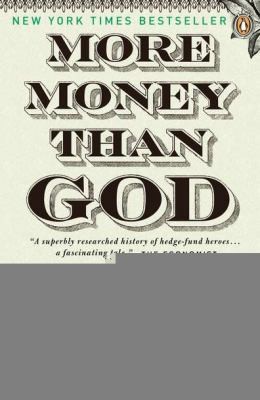
Book summary
More Money Than God by Sebastian Mallaby is a sweeping history of the hedge-fund industry from its origins in the 1960s through the financial crisis of 2007-2009. Drawing on extensive interviews, it profiles the brilliant, eccentric, and often ruthless titans such as Ken Griffin, Julian Robertson, Paul Tudor Jones, and Michael Steinhardt who repeatedly defied academic orthodoxy by beating the market through a mix of quantitative models, psychological insight, and bold risk-taking. Mallaby shows how their relentless innovation created new financial instruments, concentrated enormous wealth and power, and ultimately helped rewrite the rules of modern capitalism while exposing the system to greater systemic dangers. The core argument is that hedge funds are neither the unalloyed villains nor infallible geniuses of popular narrative but a transformative and potentially destabilizing force whose successes and failures reveal the evolving nature of twenty-first-century finance.
Key founder lessons
-
1
Talent density beats credentials
Hire young, driven outsiders like Julian Robertson's athletes who outperform Ivy League analysts through raw intensity and pattern recognition.
-
2
Edge from unconventional models
Apply physics and psychology insights like Steinhardt and Jones to spot market inefficiencies others miss, creating proprietary trading edges.
-
3
Adapt or die in crises
Survive 2008 by evolving strategies rapidly, as top funds did, turning systemic shocks into asymmetric opportunities.
-
4
Psychological mastery wins
Cultivate emotional discipline to hold contrarian bets, mirroring Jones' shark-like focus amid volatility and drawdowns.
-
5
Innovation spawns new markets
Create exotic instruments and rewrite rules, as early funds did, to capture first-mover advantages in evolving financial ecosystems.
Grok's review
Compelling history, but padded and now dated.
Mallaby delivers a richly reported narrative that humanizes the hedge-fund titans and shows how a handful of obsessive outsiders repeatedly rewrote the rules of markets. The best sections (Steinhardt, Robertson, Jones) read like founder biographies with all the ego, risk tolerance, and psychological quirks that startup people will instantly recognize. Yet the book is weakened by repetition, extended side-quests into macro history that dilute the core story, and evidence that sometimes feels more anecdotal than rigorous. Its 2010 perspective also leaves the last fifteen years of quant dominance, crypto, and retail trading platforms untouched, so today's founder gets only half the picture. Still worth reading if you want to understand the DNA of high-conviction, edge-seeking capital allocators.
Best for: Founders who want to study extreme conviction and market psychology
Similar books
-

The man who solved the market
Gregory Zuckerman
Reveals Jim Simons' quantitative hedge fund empire and the power of data-driven decision making.
-
Flash Boys
Michael Lewis
Exposes high-frequency trading and market structure, teaching speed, incentives, and competitive edges.
-

The Spider Network
David Enrich
Chronicles the LIBOR scandal, highlighting ethics, manipulation, and risk management in finance.
-

Liar's Poker
Michael Lewis, Blanca Ribera de Madariaga
Captures 1980s Wall Street culture with sharp lessons on sales, culture, and trading psychology.
-
Fooled by randomness
Nassim Nicholas Taleb
Explores luck versus skill in markets, sharpening probabilistic thinking crucial for founders.
-

The Psychology of Money
Morgan Housel
Distills timeless behavioral lessons on wealth, risk, and decision-making under uncertainty.
Founder activity
Nobody has shelved this yet
Be the first founder to add it.