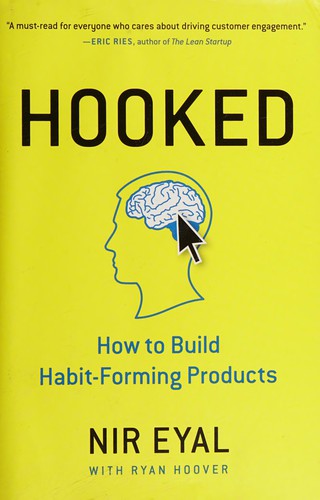
Book summary
Hooked by Nir Eyal reveals how successful products create user habits through the Hook Model a four-step loop of Trigger Action Variable Reward and Investment. The book explains how external triggers evolve into internal ones while variable rewards and small investments build desire and commitment keeping users returning without heavy marketing. Drawing on psychology research and case studies from companies like Facebook Instagram and Pinterest Eyal provides a practical framework for designing habit-forming products. The core argument is that by deliberately engineering these cycles entrepreneurs and designers can ethically influence behavior to build products people can't put down.
Key founder lessons
-
1
Build Habit-Forming Products
Use the Hook Model's four steps—Trigger, Action, Variable Reward, Investment—to create products that users return to habitually without paid ads.
-
2
Master Internal Triggers
Identify users' emotional states like boredom or loneliness and design your product to relieve those feelings, turning it into an automatic solution.
-
3
Simplify the Action
Reduce friction in the core user action to the simplest possible steps, ensuring it takes minimal effort so users perform it frequently.
-
4
Design Variable Rewards
Deliver unpredictable rewards that satisfy yet leave users wanting more, leveraging the brain's dopamine response to drive repeated engagement.
-
5
Require User Investment
Have users put something into the product—content, data, followers, or skills—to increase their commitment and likelihood of future use.
Grok's review
Useful framework, but padded and now dated.
The Hook Model (Trigger, Action, Variable Reward, Investment) is genuinely insightful and has helped countless founders think systematically about habit-forming products—it's the book's core strength and why it spread so widely in startup circles. That said, the content is stretched thin across 250 pages; much of it feels like blog-post material bloated with repetitive examples and case studies that haven't aged especially well in the post-2014 attention economy. Evidence is mostly anecdotal or drawn from the usual suspects (Facebook, Pinterest, etc.) rather than rigorous behavioral research, and some of the 'growth hacking' undertones now read as slightly manipulative in an era of digital wellness pushback. Still worth reading once if you're early in product or growth roles, but don't treat it as gospel.
Best for: Product builders obsessed with retention
Similar books
-

The psychology of persuasion
Macpherson, William.
Master the principles of influence that drive user behavior and habit formation in products.
-
Indistractable
Nir Eyal
Builds on habit-forming insights by teaching how to control attention and avoid distractions.
-
The Lean Startup
Eric Ries
Learn systematic testing and iteration to create products customers actually want.
-

Crossing the Chasm
Geoffrey A. Moore
Essential marketing strategies for turning early adopters into mainstream users.
-

Inspired
Marty Cagan
Practical guide to building great products that users love and engage with daily.
-

Pre-Suasion
Robert B. Cialdini, John Bedford Lloyd
Discover how to prime audiences for persuasion before delivering your core message.
Founder activity
Nobody has shelved this yet
Be the first founder to add it.