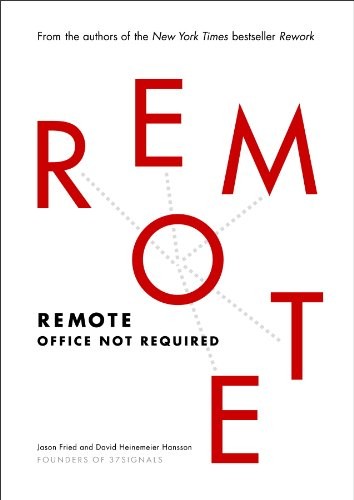
Book summary
Remote: Office Not Required by Jason Fried and David Heinemeier Hansson argues that the traditional office is an outdated and inefficient way to work, and that distributed remote teams can be more productive, flexible, and happy when given the right tools and trust. The authors draw from their experience building Basecamp as a fully remote company to show how communication, hiring, collaboration, and culture can thrive without physical co-location. They dismantle common objections about remote work while offering practical advice on asynchronous communication, avoiding meetings, and measuring results by output rather than presence. The core argument is that remote work is not a perk or compromise but a superior model that frees both companies and employees from the constraints of the 9-to-5 office.
Key founder lessons
-
1
Embrace async communication
Replace real-time meetings with written updates and recorded videos to let founders and teams work without interruptions, as the book shows this boosts deep work and output.
-
2
Hire for talent, not location
Build your team from the global talent pool instead of limiting to local hires, allowing access to better people at lower costs without office overhead.
-
3
Design for focused work
Create policies and tools that minimize distractions like open offices or constant chat, enabling the long stretches of concentration that produce great software and ideas.
-
4
Trust over tracking
Measure results by outcomes delivered rather than hours logged or presence, fostering a culture where remote employees take ownership without micromanagement.
-
5
Limit company growth pace
Grow deliberately and stay small longer by using remote work to avoid unnecessary hires and infrastructure, preserving culture and profitability as Basecamp exemplifies.
Grok's review
Still relevant but padded and preachy.
Remote makes a compelling case for distributed work that many founders needed to hear in 2013 and again in 2020; the core arguments around autonomy, async communication, and hiring beyond talent pools still hold up and have been validated by the post-pandemic shift. However, it's thin on rigorous evidence, leans heavily on Basecamp's own success as anecdotal proof, and feels padded with repetitive slogans and design-heavy pages that could have been a long blog post. The tone is often smug and dismissive of office culture in ways that feel dated now that hybrid models dominate, and it underplays real challenges like culture-building, onboarding, and time-zone friction that later books addressed more thoughtfully. Worth skimming if you haven't read it, but don't treat it as gospel.
Best for: Founders skeptical of traditional offices
Similar books
-

Rework
Jason Fried, David Heinemeier Hansson
Challenges conventional business thinking with practical, no-nonsense advice on building and running a company.
-

The 4-Hour Workweek
Timothy Ferriss
Shows how to design a lifestyle business with automation, outsourcing, and remote freedom for maximum productivity.
-
Deep Work
Cal Newport
Teaches how to cultivate intense focus and eliminate distractions to produce high-value work in a distracted world.
-
The Lean Startup
Eric Ries
Provides a scientific approach to building businesses through continuous innovation, testing, and iteration.
-

It Doesn't Have to Be Crazy at Work
Jason Fried, David Heinemeier Hansson
Reveals calmer, saner ways to run a company with better culture, less stress, and sustainable growth.
-
Essentialism
Greg McKeown
Helps founders focus on what truly matters, eliminate the nonessential, and make smarter trade-offs.
Founder activity
Nobody has shelved this yet
Be the first founder to add it.