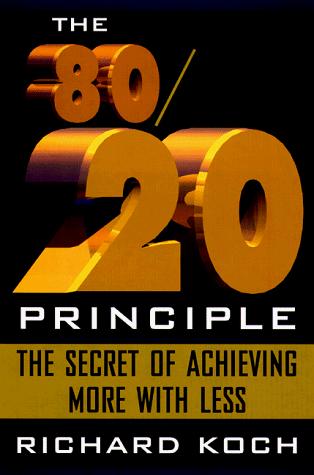
Book summary
The 80/20 Principle by Richard Koch explores the universal pattern of predictable imbalance first identified by economist Vilfredo Pareto in which roughly 20 percent of causes produce 80 percent of results in virtually every area of life. The book demonstrates this through examples from business such as 20 percent of products generating 80 percent of profits and 20 percent of customers accounting for 80 percent of revenue as well as personal productivity and relationships. Its core argument is that most effort is wasted on low-value activities so by identifying and intensely focusing resources on the vital 20 percent that truly matters individuals and organizations can achieve far more with far less time money and energy. Koch provides practical guidance for applying the principle to multiply effectiveness in work careers and daily life.
Key founder lessons
-
1
Focus on the vital 20% of customers
Identify the 20% of customers generating 80% of revenue and prioritize serving them to maximize profits with minimal effort.
-
2
Concentrate on top 20% of products
Pinpoint the 20% of products driving 80% of sales and profits, then allocate resources there while pruning the rest.
-
3
Apply 80/20 to time management
Audit activities to find the 20% of tasks yielding 80% of results and eliminate or delegate the low-value 80%.
-
4
Leverage predictable imbalance in strategy
Recognize that 80% of outcomes stem from 20% of causes, using this to simplify business models and decisions.
-
5
Multiply effectiveness through selective focus
Continuously seek new 80/20 opportunities in operations and innovation to achieve exponentially more with less input.
Grok's review
Useful idea, padded into a repetitive slog.
The core 80/20 insight is genuinely powerful for founders: most of your revenue comes from a handful of products, customers, and activities, so ruthlessly cut the rest. Koch hammers this home with business examples that still feel relevant, and the sections on applying it to time management and strategy can deliver real leverage if you actually execute. But the book is bloated with repetition, filler anecdotes, and overclaims that stretch the principle into a universal life philosophy without much new data or rigor beyond Pareto's original observation; it reads like a 1990s business airport read that could have been a long essay. Evidence is thin and dated, with too many unproven assertions about how 80/20 magically applies to everything from relationships to software bugs. Worth skimming for the framework if you've never encountered it, but don't expect depth or modernity.
Best for: Founders who need permission to focus and prune.
Similar books
-

The One Thing
Gary Keller, Jay Papasan
Focuses on identifying and prioritizing the single most important task, amplifying productivity like the 80/20 rule.
-
Essentialism
Greg McKeown
Teaches disciplined pursuit of less to achieve more, echoing the principle of focusing on vital few efforts.
-
Deep Work
Cal Newport
Shows how cultivating intense focus on high-value tasks drives exceptional results and career success.
-

Atomic Habits
James Clear
Reveals how small changes compound into remarkable productivity and business growth outcomes.
-

Good to Great
Collins, James C., Jim Collins
Identifies principles that enable companies to achieve breakthrough performance by focusing on what truly matters.
-
The Lean Startup
Eric Ries
Emphasizes validated learning and eliminating waste to efficiently build successful ventures.
Founder activity
Nobody has shelved this yet
Be the first founder to add it.