Book summary
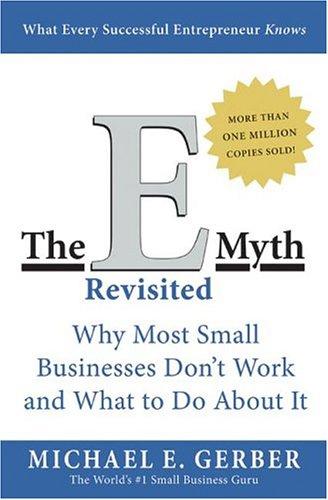
The E-Myth Revisited by Michael E. Gerber argues that most small businesses fail because owners mistakenly believe that technical expertise in a craft is enough to succeed as an entrepreneur. Gerber dismantles the "entrepreneurial myth" and explains that businesses typically pass through infancy, adolescence, and maturity stages, with many getting stuck or dying in the first two due to the owner's tendency to work "in" the business as a technician rather than "on" it as a strategic leader. Drawing on franchising principles, he advocates building a business that runs systematically like a well-oiled machine through clear processes, roles, and innovation, allowing it to thrive independently of the founder. Ultimately the book teaches that turning a business into a predictable, scalable entity requires working on the business itself as the primary product.
Key founder lessons
-
1
Work ON the business, not IN it
Founders must shift from doing technician tasks to building systems that run without them daily.
-
2
Embrace the entrepreneurial perspective
View your startup as a franchise prototype to create scalable, repeatable processes from the start.
-
3
Build a turn-key business system
Design every aspect so it can operate predictably like a McDonald's, enabling growth without chaos.
-
4
Navigate infancy to adolescence wisely
Anticipate growing pains by installing management systems early to avoid the fatal technician trap.
-
5
Infuse the primary aim
Define your personal life goals first, then architect the business to serve them rather than consume you.
Grok's review
Still useful but padded and dated.
The core insight—most owners work *in* their business instead of *on* it, and the fix is to treat it like a franchise with repeatable systems—is genuinely valuable for any founder scaling beyond solo mode. Gerber's stages-of-business metaphor (infancy, adolescence, maturity) helps reframe chaos into something predictable. That said, the book is bloated with repetitive anecdotes, fictional dialogues that feel like filler, and ideas that haven't aged perfectly (heavy franchise worship in a software-first world). Evidence is mostly anecdotal, with little data or modern case studies beyond Gerber's own seminars. It's worth a founder's time if you can skim the padding, but don't treat it as gospel.
Best for: Solopreneurs turning into real companies.
Similar books
-

Built to Last
Collins, James C., Jim Collins
Shows how to build enduring companies with core values and adaptability beyond just operations.
-

Good to Great
Collins, James C., Jim Collins
Identifies principles that transform good companies into truly great ones with disciplined execution.
-
The Lean Startup
Eric Ries
Teaches systematic innovation and testing to build scalable businesses efficiently.
-

Traction
Gino Wickman
Provides a practical system for running day-to-day operations and scaling your business.
-

Scaling Up
Verne Harnish
Outlines tools and habits to successfully grow your company while maintaining control.
-

High Output Management
Andrew S. Grove
Delivers timeless lessons on productivity, team management, and operational excellence.
Founder activity
Nobody has shelved this yet
Be the first founder to add it.