Book summary
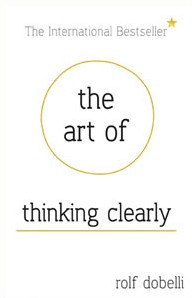
The Art of Thinking Clearly by Rolf Dobelli is a practical guide to the most common cognitive biases and mental errors that distort human judgment and decision making. Organized into 99 short chapters each focusing on a specific bias or fallacy such as the sunk cost fallacy confirmation bias or the halo effect the book explains how these everyday psychological traps lead people to invest in losing endeavors persist with harmful habits or misread situations. Dobelli's core argument is that by becoming aware of these systematic errors and learning to spot them in real time anyone can think more rationally sidestep avoidable mistakes and make clearer better choices in work relationships and life.
Key founder lessons
-
1
Avoid sunk cost fallacy
Founders must abandon failing projects early instead of pouring more resources into them just because time and money were already invested.
-
2
Overcome overconfidence effect
Startup leaders should seek external feedback and data to counter inflated self-assessments of their venture's success probability.
-
3
Recognize confirmation bias
Entrepreneurs need to actively hunt for disconfirming evidence rather than only consuming information that supports their initial business hypothesis.
-
4
Resist social proof
Founders must evaluate opportunities independently instead of following competitors or investors into crowded markets or trends.
-
5
Escape negativity bias
Leaders should balance focus on risks with deliberate attention to positive signals to avoid overly pessimistic strategic decisions.
Grok's review
Useful starter on biases, but padded and shallow.
Dobelli's book is a brisk tour through 99 cognitive biases, each in bite-sized chapters that make it easy to digest on a flight or between meetings. The strength is its clarity and breadth; as a founder you'll recognize many traps that kill startups (sunk-cost fallacy, overconfidence, social proof run amok). Yet it's weakened by repetition, filler chapters that feel like blog posts stretched thin, and evidence that's often anecdotal or cherry-picked rather than rigorous. Dated in places and lacking the depth of Kahneman's Thinking, Fast and Slow, it still beats most pop-psych books for practical awareness. Worth skimming once, not studying.
Best for: Founders seeking quick bias literacy
Similar books
-

Thinking, fast and slow
Daniel Kahneman
Reveals cognitive biases and decision-making pitfalls every founder must navigate daily.
-
Fooled by randomness
Nassim Nicholas Taleb
Exposes how luck and randomness affect success, sharpening founder judgment under uncertainty.
-

The Psychology of Money
Morgan Housel
Timeless lessons on behavior with money, crucial for startup finance and investor relations.
-

Atomic Habits
James Clear
Practical system for building productive routines that scale with company growth.
-

Predictably Irrational
Dan Ariely
Uncovers hidden forces driving human decisions, vital for product, sales, and leadership.
Founder activity
Nobody has shelved this yet
Be the first founder to add it.